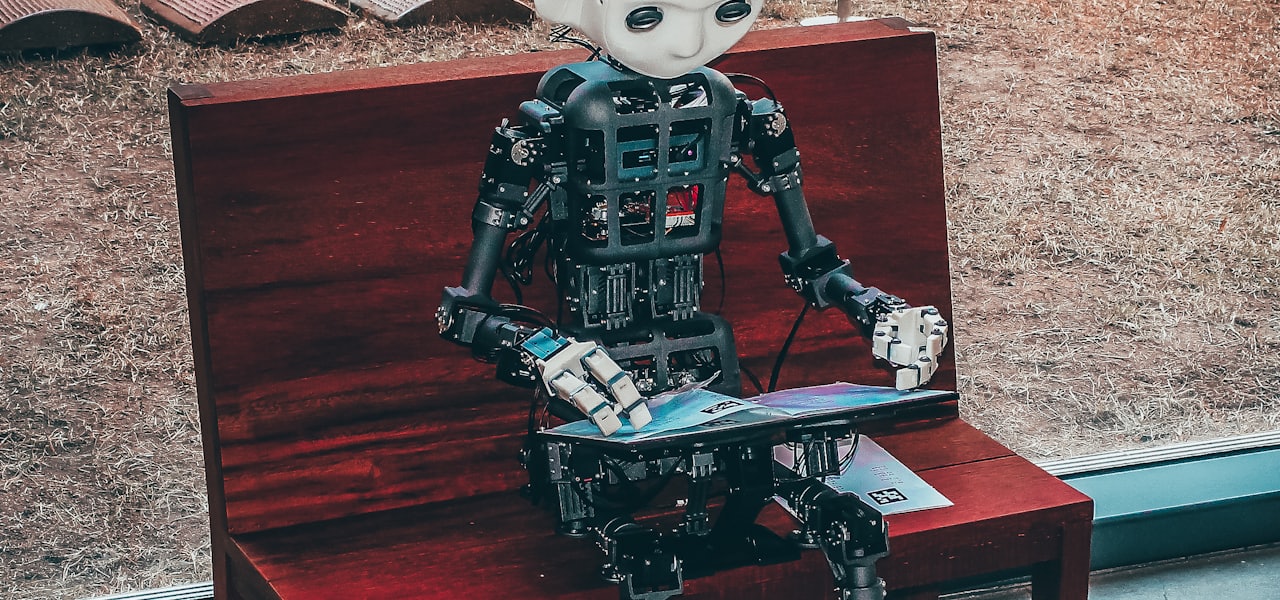
In computer science, a software agent is a computer program that acts for a user or another program in a relationship of agency. The term agent is derived from the Latin agere (to do): an agreement to act on one's behalf. Such "action on behalf of" implies the authority to decide which, if any, action is appropriate. Some agents are colloquially known as bots, from robot. They may be embodied, as when execution is paired with a robot body, or as software such as a chatbot executing on a computer, such as a mobile device, e.g. Siri. Software agents may be autonomous or work together with other agents or people. Software agents interacting with people (e.g. chatbots, human-robot interaction environments) may possess human-like qualities such as natural language understanding and speech, personality or embody humanoid form (see Asimo). Related and derived concepts include intelligent agents (in particular exhibiting some aspects of artificial intelligence, such as reasoning), autonomous agents (capable of modifying the methods of achieving their objectives), distributed agents (being executed on physically distinct computers), multi-agent systems (distributed agents that work together to achieve an objective that could not be accomplished by a single agent acting alone), and mobile agents (agents that can relocate their execution onto different processors). == Concepts == The basic attributes of an autonomous software agent are that agents: are not strictly invoked for a task, but activate themselves, may reside in wait status on a host, perceiving context, may get to run status on a host upon starting conditions, do not require interaction of user, may invoke other tasks including communication. The concept of an agent provides a method of describing a complex software entity that is capable of acting with a certain degree of autonomy in order to accomplish tasks on behalf of its host. But unlike objects, which are defined in terms of methods and attributes, an agent is defined in terms of its behavior. Various authors have proposed different definitions of agents, these commonly include concepts such as: persistence: code is not executed on demand but runs continuously and decides for itself when it should perform some activity; autonomy: agents have capabilities of task selection, prioritization, goal-directed behavior, decision-making without human intervention; social ability: agents are able to engage other components through some sort of communication and coordination, they may collaborate on a task; reactivity: agents perceive the context in which they operate and react to it appropriately. === Distinguishing agents from programs === All agents are programs, but not all programs are agents. Contrasting the term with related concepts may help clarify its meaning. Franklin & Graesser (1997) discuss four key notions that distinguish agents from arbitrary programs: reaction to the environment, autonomy, goal-orientation and persistence. === Intuitive distinguishing agents from objects === Agents are more autonomous than objects. Agents have flexible behavior: reactive, proactive, social. Agents have at least one thread of control but may have more. === Distinguishing agents from expert systems === Expert systems are not coupled to their environment. Expert systems are not designed for reactive, proactive behavior. Expert systems do not consider social ability. === Distinguishing intelligent software agents from intelligent agents in AI === Intelligent agents (also known as rational agents) are not just computer programs: they may also be machines, human beings, communities of human beings (such as firms) or anything that is capable of goal-directed behavior. == Impact of software agents == Software agents may offer various benefits to their end users by automating complex or repetitive tasks. However, there are organizational and cultural impacts of this technology that need to be considered prior to implementing software agents. === Organizational impact === === Work contentment and job satisfaction impact === People like to perform easy tasks providing the sensation of success unless the repetition of the simple tasking is affecting the overall output. In general implementing software agents to perform administrative requirements provides a substantial increase in work contentment, as administering their own work does never please the worker. The effort freed up serves for a higher degree of engagement in the substantial tasks of individual work. Hence, software agents may provide the basics to implement self-controlled work, relieved from hierarchical controls and interference. Such conditions may be secured by application of software agents for required formal support. === Cultural impact === The cultural effects of the implementation of software agents include trust affliction, skills erosion, privacy attrition and social detachment. Some users may not feel entirely comfortable fully delegating important tasks to software applications. Those who start relying solely on intelligent agents may lose important skills, for example, relating to information literacy. In order to act on a user's behalf, a software agent needs to have a complete understanding of a user's profile, including his/her personal preferences. This, in turn, may lead to unpredictable privacy issues. When users start relying on their software agents more, especially for communication activities, they may lose contact with other human users and look at the world with the eyes of their agents. These consequences are what agent researchers and users must consider when dealing with intelligent agent technologies. === History === The concept of an agent can be traced back to Hewitt's Actor Model (Hewitt, 1977) - "A self-contained, interactive and concurrently-executing object, possessing internal state and communication capability." To be more academic, software agent systems are a direct evolution of Multi-Agent Systems (MAS). MAS evolved from Distributed Artificial Intelligence (DAI), Distributed Problem Solving (DPS) and Parallel AI (PAI), thus inheriting all characteristics (good and bad) from DAI and AI. John Sculley's 1987 "Knowledge Navigator" video portrayed an image of a relationship between end-users and agents. Being an ideal first, this field experienced a series of unsuccessful top-down implementations, instead of a piece-by-piece, bottom-up approach. The range of agent types is now (from 1990) broad: WWW, search engines, etc. == Examples of intelligent software agents == === Buyer agents (shopping bots) === Buyer agents travel around a network (e.g. the internet) retrieving information about goods and services. These agents, also known as 'shopping bots', work very efficiently for commodity products such as CDs, books, electronic components, and other one-size-fits-all products. Buyer agents are typically optimized to allow for digital payment services used in e-commerce and traditional businesses. === User agents (personal agents) === User agents, or personal agents, are intelligent agents that take action on your behalf. In this category belong those intelligent agents that already perform, or will shortly perform, the following tasks: Check your e-mail, sort it according to the user's order of preference, and alert you when important emails arrive. Play computer games as your opponent or patrol game areas for you. Assemble customized news reports for you. There are several versions of these, including CNN. Find information for you on the subject of your choice. Fill out forms on the Web automatically for you, storing your information for future reference Scan Web pages looking for and highlighting text that constitutes the "important" part of the information there Discuss topics with you ranging from your deepest fears to sports Facilitate with online job search duties by scanning known job boards and sending the resume to opportunities who meet the desired criteria Profile synchronization across heterogeneous social networks === Monitoring-and-surveillance (predictive) agents === Monitoring and surveillance agents are used to observe and report on equipment, usually computer systems. The agents may keep track of company inventory levels, observe competitors' prices and relay them back to the company, watch stock manipulation by insider trading and rumors, etc. For example, NASA's Jet Propulsion Laboratory has an agent that monitors inventory, planning, schedules equipment orders to keep costs down, and manages food storage facilities. These agents usually monitor complex computer networks that can keep track of the configuration of each computer connected to the network. A special case of monitoring-and-surveillance agents are organizations of agents used to automate decision-making process during tactical operations. The agents monitor the status of assets (ammunition, weapons available, platforms for transport, etc.) and receive goals from hi
IMazing
iMazing is mobile device management software that allows users to transfer files and data between iOS devices (iPhone, iPad and iPod Touch) and macOS or Windows computers, in addition to many other features beyond the scope of what Apple's own tools enable. == History == Developed by DigiDNA, iMazing was initially released in 2008 as DiskAid, enabling users to transfer data and files from the iPhone or iPod Touch to Mac or Windows computers. DiskAid was renamed iMazing in 2014. Version 2.0 was released on September 13, 2016. In August 2021, version 2.14 of iMazing added a spyware detection feature. The feature is based on Amnesty International’s Mobile Verification Toolkit to detect Pegasus Spyware following the publication of Pegasus Project. == Description == With iMazing, an iPhone or iPad can be used similarly to an external hard drive. It performs tasks that iTunes doesn’t offer, including incremental backups of iOS devices, browsing and exporting text and voicemail messages, managing apps, encryption, and migrating data from an old phone to a new one. The menu bar app iMazing Mini enables automatic, wireless and encrypted backups of iPhones. The iMazing HEIC Converter is a free desktop app for Mac and PC that lets users convert photos from HEIC format to JPG or PNG.
Secure element
A secure element (SE) is a secure operating system (OS) in a tamper-resistant processor chip or secure component. It can protect assets (root of trust, sensitive data, keys, certificates, applications) against high-level software and hardware attacks. Applications that process this sensitive data on an SE are isolated and so operate within a controlled environment not affected by software (including possible malware) found elsewhere on the OS. The hardware and embedded software meet the requirements of the Security IC Platform Protection Profile [PP 0084] including resistance to physical tampering scenarios described within it. More than 96 billion secure elements were produced and shipped between 2010 and 2021. SEs exist in various form factors, as devices such as smart cards, UICCs, or smart microSD cards, or embedded, or integrated, as parts of larger devices. SEs are an evolution of the chips in earlier smart cards, which have been adapted to suit the needs of numerous use cases, such as smartphones, tablets, set-top boxes, wearables, connected cars, and other internet of things (IoT) devices. The technology is widely used by technology firms such as Oracle, Apple and Samsung. SEs provide secure isolation, storage and processing for applications (called applets) they host while being isolated from the external world (e.g. rich OS and application processor when embedded in a smartphone) and from other applications running on the SE. Java Card and MULTOS are the most deployed standardized multi-application operating systems currently used to develop applications running on SEs. Since 1999, GlobalPlatform has been the body responsible for standardizing secure element technologies to support a dynamic model of application management in a multi-actor model. GlobalPlatform also runs Functional and Security Certification programmes for secure elements, and hosts a list of Functional Certified and Security Certified products. GlobalPlatform technology is also embedded in other standards such as ETSI SCP (now SET) since release 7. A Common Criteria Secure Element Protection Profile has been released targeting EAL4+ level with ALC_DVS.2 and AVA_VAN.5 extension to standardize the security features of a secure element across markets.
RFPolicy
The RFPolicy outlines a method for contacting vendors about security vulnerabilities found in their products. It was initially written in 2000 by hacker and security consultant Rain Forest Puppy. It was perhaps the second disclosure policy, following Simple Nomad's. The policy gives the vendor five working days to respond to the reporter of the bug. If the vendor fails to contact the reporter within those five days, the issue is recommended to be disclosed to the general community. The reporter should help the vendor reproduce the bug and work out a fix. The reporter should delay notifying the general community about the bug if the vendor provides feasible reasons for requiring so. If the vendor fails to respond or shuts down communication with the reporter of the problem within five working days, the reporter should disclose the issue to the general community. When issuing an alert or fix, the vendor should give the reporter proper credit for reporting the bug. Context for the history of vulnerability disclosure is available in a history article.
IDMS
The Integrated Database Management System (IDMS) is a network model (CODASYL) database management system for mainframes. It was first developed at BFGoodrich and later marketed by Cullinane Database Systems (renamed Cullinet in 1983). Since 1989 the product has been owned by Computer Associates (now CA Technologies), who renamed it Advantage CA-IDMS and later simply to CA IDMS. In 2018 Broadcom acquired CA Technologies, renaming it back to IDMS. == History == The roots of IDMS go back to the pioneering database management system called Integrated Data Store (IDS), developed at General Electric by a team led by Charles Bachman and first released in 1964. In the early 1960s IDS was taken from its original form, by the computer group of the BFGoodrich Chemical Division, and re-written in a language called Intermediate System Language (ISL). ISL was designed as a portable system programming language able to produce code for a variety of target machines. Since ISL was actually written in ISL, it was able to be ported to other machine architectures with relative ease, and then to produce code that would execute on them. The Chemical Division computer group had given some thought to selling copies of IDMS to other companies, but was told by management that they were not in the software products business. Eventually, a deal was struck with John Cullinane to buy the rights and market the product. Because Cullinane was required to remit royalties back to B.F. Goodrich, all add-on products were listed and billed as separate products – even if they were mandatory for the core IDMS product to work. This sometimes confused customers. The original platforms were the GE 235 computer and GE DATANET-30 message switching computer: later the product was ported to IBM mainframes and to DEC and ICL hardware. The IBM-ported version runs on IBM mainframe systems (System/360, System/370, System/390, zSeries, System z9). In the mid-1980s, it was claimed that some 2,500 IDMS licenses had been sold. Users included the Strategic Air Command, Ford of Canada, Ford of Europe, Jaguar Cars, Clarks Shoes UK, Axa/PPP, MAPFRE, Royal Insurance, Tesco, Manulife, Hudson's Bay Company, Cleveland Clinic, Bank of Canada, General Electric, Aetna and BT in the UK. A version for use on the Digital Equipment Corporation PDP-11 series of computers was sold to DEC and was marketed as DBMS-11. In 1976 the source code was licensed to ICL, who ported the software to run on their 2900 series mainframes, and subsequently also on the older 1900 range. ICL continued development of the software independently of Cullinane, selling the original ported product under the name ICL 2900 IDMS and an enhanced version as IDMSX. In this form it was used by many large UK users, an example being the Pay-As-You-Earn system operated by Inland Revenue. Many of these IDMSX systems for UK Government were still running in 2013. In the early to mid-1980s, relational database management systems started to become more popular, encouraged by increasing hardware power and the move to minicomputers and client–server architecture. Relational databases offered improved development productivity over CODASYL systems, and the traditional objections based on poor performance were slowly diminishing. Cullinet attempted to continue competing against IBM's DB2 and other relational databases by developing a relational front-end and a range of productivity tools. These included Automatic System Facility (ASF), which made use of a pre-existing IDMS feature called LRF (Logical Record Facility). ASF was a fill-in-the-blanks database generator that would also develop a mini-application to maintain the tables. It is difficult to judge whether such features may have been successful in extending the selling life of the product, but they made little impact in the long term. Those users who stayed with IDMS were primarily interested in its high performance, not in its relational capabilities. It was widely recognized (helped by a high-profile campaign by E. F. Codd, the father of the relational model) that there was a significant difference between a relational database and a network database with a relational veneer. In 1989 Computer Associates continued after Cullinet acquisition with the development and released Release 12.0 with full SQL in 1992–93. CA Technologies continued to market and support the CA IDMS and enhanced IDMS in subsequent releases by TCP/IP support, two phase commit support, XML publishing, zIIP specialty processor support, Web-enabled access in combination with CA IDMS Server, SQL Option and GUI database administration via CA IDMS Visual DBA tool. CA-IDMS systems are today still running businesses worldwide. Many customers have opted to web-enable their applications via the CA-IDMS SQL Option which is part of CA Technologies' Dual Database Strategy. == Integrated Data Dictionary == One of the sophisticated features of IDMS was its built-in Integrated data dictionary (IDD). The IDD was primarily developed to maintain database definitions. It was itself an IDMS database. DBAs (database administrators) and other users interfaced with the IDD using a language called Data Dictionary Definition Language (DDDL). IDD was also used to store definitions and code for other products in the IDMS family such as ADS/Online and IDMS-DC. IDD's power was that it was extensible and could be used to create definitions of just about anything. Some companies used it to develop in-house documentation. == Overview == === Logical Data Model === The data model offered to users is the CODASYL network model. The main structuring concepts in this model are records and sets. Records essentially follow the COBOL pattern, consisting of fields of different types: this allows complex internal structure such as repeating items and repeating groups. The most distinctive structuring concept in the Codasyl model is the set. Not to be confused with a mathematical set, a Codasyl set represents a one-to-many relationship between records: one owner, many members. The fact that a record can be a member in many different sets is the key factor that distinguishes the network model from the earlier hierarchical model. As with records, each set belongs to a named set type (different set types model different logical relationships). Sets are in fact ordered, and the sequence of records in a set can be used to convey information. A record can participate as an owner and member of any number of sets. Records have identity, the identity being represented by a value known as a database key. In IDMS, as in most other Codasyl implementations, the database key is directly related to the physical address of the record on disk. Database keys are also used as pointers to implement sets in the form of linked lists and trees. This close correspondence between the logical model and the physical implementation (which is not a strictly necessary part of the Codasyl model, but was a characteristic of all successful implementations) is responsible for the efficiency of database retrieval, but also makes operations such as database loading and restructuring rather expensive. Records can be accessed directly by database key, by following set relationships, or by direct access using key values. Initially the only direct access was through hashing, a mechanism known in the Codasyl model as CALC access. In IDMS, CALC access is implemented through an internal set, linking all records that share the same hash value to an owner record that occupies the first few bytes of every disk page. In subsequent years, some versions of IDMS added the ability to access records using BTree-like indexes. === Storage === IDMS organizes its databases as a series of files. These files are mapped and pre-formatted into so-called areas. The areas are subdivided into pages which correspond to physical blocks on the disk. The database records are stored within these blocks. The DBA allocates a fixed number of pages in a file for each area. The DBA then defines which records are to be stored in each area, and details of how they are to be stored. IDMS intersperses special space-allocation pages throughout the database. These pages are used to keep track of the free space available in each page in the database. To reduce I/O requirements, the free space is only tracked for all pages when the free space for the area falls below 30%. Four methods are available for storing records in an IDMS database: Direct, Sequential, CALC, and VIA. The Fujitsu/ICL IDMSX version extends this with two more methods, Page Direct, and Random. In direct mode the target database key is specified by the user and is stored as close as possible to that DB key, with the actual DB key on which the record is stored being returned to the application program. Sequential placement (not to be confused with indexed sequential), simply places each new record at the end of the area. This option is rarely used. CALC uses a hashing algo
Symbol level
In knowledge-based systems, agents choose actions based on the principle of rationality to move closer to a desired goal. The agent is able to make decisions based on knowledge it has about the world (see knowledge level). But for the agent to actually change its state, it must use whatever means it has available. This level of description for the agent's behavior is the symbol level. The term was coined by Allen Newell in 1982. For example, in a computer program, the knowledge level consists of the information contained in its data structures that it uses to perform certain actions. The symbol level consists of the program's algorithms, the data structures themselves, and so on.
Connection string
In computing, a connection string is a string that specifies information about a data source and the means of connecting to it. It is passed in code to an underlying driver or provider in order to initiate the connection. Whilst commonly used for a database connection, the data source could also be a spreadsheet or text file. The connection string may include attributes such as the name of the driver, server and database, as well as security information such as user name and password. == Examples == This example shows a PostgreSQL connection string for connecting to wikipedia.com with SSL and a connection timeout of 180 seconds: DRIVER={PostgreSQL Unicode};SERVER=www.wikipedia.com;SSL=true;SSLMode=require;DATABASE=wiki;UID=wikiuser;Connect Timeout=180;PWD=ashiknoor Users of Oracle databases can specify connection strings: on the command line (as in: sqlplus scott/tiger@connection_string ) via environment variables ($TWO_TASK in Unix-like environments; %TWO_TASK% in Microsoft Windows environments) in local configuration files (such as the default $ORACLE_HOME/network/admin.tnsnames.ora) in LDAP-capable directory services