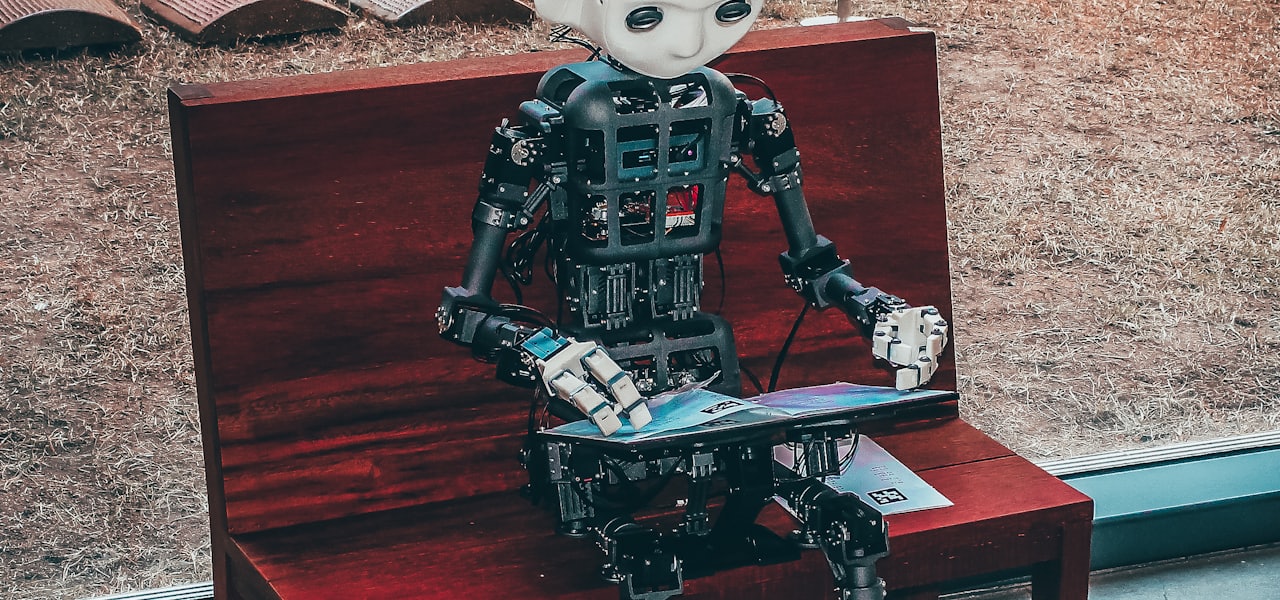
Virtual intelligence (VI) is the term given to artificial intelligence that exists within a virtual world. Many virtual worlds have options for persistent avatars that provide information, training, role-playing, and social interactions. The immersion in virtual worlds provides a platform for VI beyond the traditional paradigm of past user interfaces (UIs). What Alan Turing established as a benchmark for telling the difference between human and computerized intelligence was devoid of visual influences. With today's VI bots, virtual intelligence has evolved past the constraints of past testing into a new level of the machine's ability to demonstrate intelligence. The immersive features of these environments provide nonverbal elements that affect the realism provided by virtually intelligent agents. Virtual intelligence is the intersection of these two technologies: Virtual environments: Immersive 3D spaces provide for collaboration, simulations, and role-playing interactions for training. Many of these virtual environments are currently being used for government and academic projects, including Second Life, VastPark, Olive, OpenSim, Outerra, Oracle's Open Wonderland, Duke University's Open Cobalt, and many others. Some of the commercial virtual worlds are also taking this technology into new directions, including the high-definition virtual world Blue Mars. Artificial intelligence (AI): AI is a branch of computer science that aims to create intelligent machines capable of performing tasks that typically require human intelligence. VI is a type of AI that operates within virtual environments to simulate human-like interactions and responses. == Applications == Cutlass Bomb Disposal Robot: Northrop Grumman developed a virtual training opportunity because of the prohibitive real-world cost and dangers associated with bomb disposal. By replicating a complicated system without having to learn advanced code, the virtual robot has no risk of damage, trainee safety hazards, or accessibility constraints. MyCyberTwin: NASA is among the companies that have used the MyCyberTwin AI technologies. They used it for the Phoenix rover in the virtual world Second Life. Their MyCyberTwin used a programmed profile to relay information about what the Phoenix rover was doing and its purpose. Second China: The University of Florida developed the "Second China" project as an immersive training experience for learning how to interact with the culture and language in a foreign country. Students are immersed in an environment that provides role-playing challenges coupled with language and cultural sensitivities magnified during country-level diplomatic missions or during times of potential conflict or regional destabilization. The virtual training provides participants with opportunities to access information, take part in guided learning scenarios, communicate, collaborate, and role-play. While China was the country for the prototype, this model can be modified for use with any culture to help better understand social and cultural interactions and see how other people think and what their actions imply. Duke School of Nursing Training Simulation: Extreme Reality developed virtual training to test critical thinking with a nurse performing trained procedures to identify critical data to make decisions and performing the correct steps for intervention. Bots are programmed to respond to the nurse's actions as the patient with their conditions improving if the nurse performs the correct actions.
Commission on Enhancing National Cybersecurity
The President's Commission on Enhancing National Cybersecurity is a Presidential Commission formed on April 13, 2016, to develop a plan for protecting cyberspace, and America's economic reliance on it. The commission released its final report in December 2016. The report made recommendations regarding the intertwining roles of the military, government administration and the private sector in providing cyber security. Chairman Donilon said of the report that its coverage "is unusual in the breadth of issues" with which it deals. == Recommendations == The report made sixteen major recommendations with fifty-three specific action items broadly grouped under six areas: Protecting the information and digital infrastructure Investing in the secure growth of information and digital infrastructure Consumer information access Building the cybersecurity workforce Building a secure governmental cybersecurity framework Keeping interconnectivity open, fair, competitive, and secure The Commission found that strong authentication systems were mandatory for adequate cybersecurity, not just for the government, but for all commercial systems, and private individuals. The commission also stressed remote identity proofing and security for the Internet of things (IoT). Finding that technicians who know cybersecurity and can protect systems are few and in short supply, the commission recommended nationally supported training programs to produce an adequate workforce, as well as increasing the level of expertise in the existing workforce. The Commission highlighted the importance of partnerships between government and the private sector as a powerful tool for encouraging the technology, policies and practices we need to secure and grow the digital economy. (page 2) Some criticised the commission's work as lacking an understanding of cybersecurity and not being cognizant of "cyber reality" and the cost of some of the action items, but others found the report constructive and meaningful. == Commission members == The initial members of the Commission are: Tom Donilon, former Assistant to the President and National Security Advisor (Chair) Sam Palmisano, former CEO of IBM (Vice Chair) General Keith Alexander, CEO of IronNet Cybersecurity, former Director of the National Security Agency and former Commander of U.S. Cyber Command Annie Antón, Professor and Chair of the School of Interactive Computing at Georgia Tech. Ajay Banga, President and CEO of MasterCard Steven Chabinsky, General Counsel and Chief Risk Officer of CrowdStrike Patrick Gallagher, Chancellor of the University of Pittsburgh and former Director of the National Institute of Standards and Technology Peter Lee, Corporate Vice President, Microsoft Research Herbert Lin, Senior Research Scholar for Cyber Policy and Security at the Stanford Center for International Security and Cooperation and Research Fellow at the Hoover Institution Heather Murren, former member of the Financial Crisis Inquiry Commission and co-founder of the Nevada Cancer Institute Joe Sullivan, Chief Security Officer of Uber and former Chief Security Officer of Facebook Maggie Wilderotter, Executive Chairman of Frontier Communications == Follow-on == Incoming President Trump has indicated that he wants a full review of U.S. cyber protection policy. == Notes and references ==
Mathematical knowledge management
Mathematical knowledge management (MKM) is the study of how society can effectively make use of the vast and growing literature on mathematics. It studies approaches such as databases of mathematical knowledge, automated processing of formulae and the use of semantic information, and artificial intelligence. Mathematics is particularly suited to a systematic study of automated knowledge processing due to the high degree of interconnectedness between different areas of mathematics.
Kunstweg
Bürgi's Kunstweg is a set of algorithms developed by Jost Bürgi in the late 16th century. They are used to calculate sines to arbitrary precision.. Bürgi used these algorithms to calculate a Canon Sinuum, a sine table in increments of 2 arc seconds. It is believed that the table featured values accurate to eight sexagesimal places. Some authors have speculated that the table only covered the range from 0° to 45°, although there is no evidence supporting this claim. Such tables were crucial for maritime navigation. Johannes Kepler described the Canon Sinuum as the most precise sine table known at the time. Bürgi explained his algorithms in his work Fundamentum Astronomiae, which he presented to Emperor Rudolf II in 1592. The Kunstweg algorithm calculates sine values iteratively. In each step, the value of a cell is the sum of the two preceding cells in the same column. The final cell's value is halved before beginning the next iteration. Ultimately, the values in the last column are normalized. Accurate sine approximations are achieved after only a few iterations. In 2015, Menso Folkerts and coworkers demonstrated that this iterative process does indeed converge toward the true sine values. According to them this was the first step towards differential calculus.
Paper data storage
Paper data storage refers to the use of paper as a data storage device. This includes writing, illustrating, and the use of data that can be interpreted by a machine or is the result of the functioning of a machine. A defining feature of paper data storage is the ability of humans to produce it with only simple tools and interpret it visually. Though now mostly obsolete, paper was once an important form of computer data storage as both paper tape and punch cards were a common staple of working with computers before the 1980s. == History == Before paper was used for storing data, it had been used in several applications for storing instructions to specify a machine's operation. The earliest use of paper to store instructions for a machine was the work of Basile Bouchon who, in 1725, used punched paper rolls to control textile looms. This technology was later developed into the wildly successful Jacquard loom. The 19th century saw several other uses of paper for controlling machines. In 1846, telegrams could be prerecorded on punched tape and rapidly transmitted using Alexander Bain's automatic telegraph. Several inventors took the concept of a mechanical organ and used paper to represent the music. In the late 1880s Herman Hollerith invented the recording of data on a medium that could then be read by a machine. Prior uses of machine readable media, above, had been for control (automatons, piano rolls, looms, ...), not data. "After some initial trials with paper tape, he settled on punched cards..." Hollerith's method was used in the 1890 census. Hollerith's company eventually became the core of IBM. Other technologies were also developed that allowed machines to work with marks on paper instead of punched holes. This technology was widely used for tabulating votes and grading standardized tests. Banks used magnetic ink on checks, supporting MICR scanning. In an early electronic computing device, the Atanasoff–Berry Computer, electric sparks were used to singe small holes in paper cards to represent binary data. The altered dielectric constant of the paper at the location of the holes could then be used to read the binary data back into the machine by means of electric sparks of lower voltage than the sparks used to create the holes. This form of paper data storage was never made reliable and was not used in any subsequent machine. == Modern techniques == === 1D barcodes === Barcodes make it possible for any object that was to be sold or transported to have some computer readable information securely attached to it. Universal Product Code barcodes, first used in 1974, are ubiquitous today. Some people recommend a width of at least 3 pixels for each minimum-width gap and each minimum-width bar for 1D barcodes. The density is about 50 bits per linear inch (about 2 bit/mm). === 2D barcodes === 2D barcodes allow to store much more data on paper, up to 2.9 kbyte per barcode. It is recommended to have a width of at least 4 pixels—e.g., a 4 × 4 pixel = 16 pixel module. == Limits == The limits of data storage depend on the technology to write and read such data. The theoretical limits assume a scanner that can perfectly reproduce the printed image at its printing resolution, and a program which can accurately interpret such an image. For example, an 8 in × 10 in (200 mm × 250 mm) 600 dpi black-and-white image contains 3.43 MiB of data, as does a 300 dpi CMYK printed image. A 2,400 ppi True color (24-bit) image contains about 1.29 GiB of information; printing an image maintaining this data would require a printing resolution of about 120,000 dpi in black and white, or 60,000 dpi with CMYK dots.
Elastix (image registration)
Elastix is an image registration toolbox built upon the Insight Segmentation and Registration Toolkit (ITK). It is entirely open-source and provides a wide range of algorithms employed in image registration problems. Its components are designed to be modular to ease a fast and reliable creation of various registration pipelines tailored for case-specific applications. It was first developed by Stefan Klein and Marius Staring under the supervision of Josien P.W. Pluim at Image Sciences Institute (ISI). Its first version was command-line based, allowing the final user to employ scripts to automatically process big data-sets and deploy multiple registration pipelines with few lines of code. Nowadays, to further widen its audience, a version called SimpleElastix is also available, developed by Kasper Marstal, which allows the integration of elastix with high level languages, such as Python, Java, and R. == Image registration fundamentals == Image registration is a well-known technique in digital image processing that searches for the geometric transformation that, applied to a moving image, obtains a one-to-one map with a target image. Generally, the images acquired from different sensors (multimodal), time instants (multitemporal), and points of view (multiview) should be correctly aligned to proceed with further processing and feature extraction. Even though there are a plethora of different approaches to image registration, the majority is composed of the same macro building blocks, namely the transformation, the interpolator, the metric, and the optimizer. Registering two or more images can be framed as an optimization problem that requires multiple iterations to converge to the best solution. Starting from an initial transformation computed from the image moments the optimization process searches for the best transformation parameters based on the value of the selected similarity metric. The figure on the right shows the high-level representation of the registration of two images, where the reference remains constant during the entire process, while the moving one will be transformed according to the transformation parameters. In other words, the registration ends when the similarity metric, which is a mathematical function with a certain number of parameters to be optimized, reaches the optimal value which is highly dependent on the specific application. == Main building blocks == Following the structure of the image registration workflow, the elastix toolbox proposes a modular solution that implements for each of the building blocks different algorithms, highly employed in medical image registration, and helps the final users to build their specific pipeline by selecting the most suitable algorithm for each of the main building blocks. Each block is easily configurable both by selecting pre-defined initialization values or by trying multiple sets of parameters and then choosing the most performing one. The registration is performed on images, and the elastix toolbox supports all the data formats supported by ITK, ranging from JPEG and PNG to medical standard formats such as DICOM and NIFTI. It also stores physical pixel spacing, the origin and the relative position to an external world reference system, when provided in the metadata, to facilitate the registration process, especially in medical field applications. === Transformation === The transformation is an essential building block, since it defines the allowable transformations. In image registration, the main distinction can be done between parallel-to-parallel and parallel-to-non parallel (deformable) line mapping transformations. In the elastix toolbox, the final users can select one transformation or compose more transformations either through addition or via composition. Below are reported the different transformation models in order of increasing flexibility, along with the corresponding elastix class names between brackets. Translation (TranslationTransform) allows only translations Rigid (EulerTransform) expands the translation adding rotations and the object is seen as a rigid body Similarity (SimilarityTransform) expands the rigid transformation by introducing isotropic scaling Affine (AffineTransform) expands the rigid transformation allowing both scaling and shear B-splines (BSplineTransform) is a deformable transformation usually preceded by a rigid or affine one Thin-plate splines (SplineKernelTransform) is a deformable transformation belonging to the class of kernel-based transformations that is a composition of and affine and a non-rigid part === Metric === The similarity metric is the mathematical function whose parameters should be optimized to reach the desired registration, and, during the process, it is computed multiple times. Below are reported the available metrics computed employing the reference and the transformed images and the corresponding elastix class names between brackets. Mean squared difference (AdvancedMeanSquares) to be used for mono-modal applications Normalized correlation coefficient (AdvancedNormalizedCorrelation) to be used for images that have an intensity linear relationship Mutual information (AdvancedMattesMutualInformation) to be used for both mono- and multi-modal applications and optimized to reach better performance compared to the normalized version Normalized mutual information (NormalizedMutualInformation) for both mono- and multi-modal applications Kappa statistic (AdvancedKappaStatistic) to be used only for binary images === Sampler === For the computation of the similarity metrics, it is not always necessary to consider all the voxels and, sometimes, it can be useful to use only a fraction of the voxels of the images, i.e. to reduce the execution time for big input images. Below are reported the available criteria for selecting a fraction of the voxels for the similarity metric computation and the corresponding elastix class names between brackets. Full (Full) to employ all the voxels Grid (Grid) to employ a regular grid defined by the user to downsample the image Random (Random) to randomly select a percentage of voxels defined by the users (all voxels have equal probability to be selected) Random coordinate (RandomCoordinate) like the random criterion, but in this case also off-grid positions can be selected to simplify the optimization process === Interpolator === After the application of the transformation, it may occur that the voxels used for the similarity metric computation are at non-voxel positions, so intensity interpolation should be performed to ensure the correctness of the computed values. Below are reported the implemented interpolators and the corresponding elastix class names between brackets. Nearest neighbor (NearestNeighborInterpolator) exploits little resources, but gives low quality results Linear (LinearInterpolator) is sufficient in general applications N-th order B-spline (BSplineInterpolator) can be used to increase the order N, increasing quality and computation time. N=0 and N=1 indicate the nearest neighbor and linear cases respectively. === Optimizer === The optimizer defines the strategy employed for searching the best transformation parameter to reach the correct registration, and it is commonly an iterative strategy. Below are reported some of the implemented optimization strategies. Gradient descent Robbins-Monro, similar to the gradient descent, but employing an approximation of the cost function derivatives A wider range of optimizers is also available, such as Quasi-Newton or evolutionary strategies. === Other features === The elastix software also offers other features that can be employed to speed up the registration procedure and to provide more advanced algorithms to the end-users. Some examples are the introduction of blur and Gaussian pyramid to reduce data complexity, and multi-image and multi-metric framework to deal with more complex applications. == Applications == Elastix has applications mainly in the medical field, where image registration is fundamental to get comprehensive information regarding the analysed anatomical region. It is widely employed in image-guided surgery, tumour monitoring, and treatment assessment. For example, in radiotherapy planning, image registration allows to correctly deliver the treatment and evaluate the obtained results. Thanks to the wide range of implemented algorithms, the use of the elastix software allows physicians and researchers to test different registration pipelines from the simplest to more complex ones, and to save the best one as a configuration file. This file and the fact that the software is completely open-source makes it easy to reproduce the work, that can help supporting the open science paradigm, and allows fast reuse on different patients data. In image-guided surgery, registration time and accuracy are critical points, considering that, during the registration, the patient is on the operating table, and the imag
Library history
Library history is a subdiscipline within library science and library and information science focusing on the history of libraries and their role in societies and cultures. Some see the field as a subset of information history. Library history is an academic discipline and should not be confused with its object of study (history of libraries): the discipline is much younger than the libraries it studies. Library history begins in ancient societies through contemporary issues facing libraries today. Topics include recording mediums, cataloguing systems, scholars, scribes, library supporters and librarians. == Earliest libraries == The earliest records of a library institution as it is presently understood can be dated back to around 5,000 years ago in the Southwest Asian regions of the world. One of the oldest libraries found is that of the ancient library at Ebla (circa 2500 BCE) in present-day Syria. In the 1970s, the excavation at Ebla's library unearthed over 20,000 clay tablets written in cuneiform script. === Library in Mesopotamia === The Assyrian King Assurbanipal created one of the greatest libraries in Nineveh in the seventh century BCE. The collection consisted of over 30,000 tablets written in a variety of languages. The collection was cataloged both by the shape of the tablet and by the subject of the content. The library had separate rooms for the different topics: government, history, law, astronomy, geography, and so on. The tablets also contained myths, hymns, and even jokes. Assurbanipal would send scribes to visit every corner of his kingdom to copy the content of other libraries. His library contained many of the most important literary works of the day, including the epic of Gilgamesh. Assurbanipal's Royal Library also had one of the first library catalogs. Unfortunately, Nineveh was eventually destroyed, and the library was lost in a fire. === Libraries in Ancient Greece === The Greek government was the first to sponsor public libraries. By 500 BCE both Athens and Samos had begun creating libraries for the public, though as most of the population was illiterate these spaces were serving a small, educated portion of the community. Athens developed a city archive at the Metroon in 405 BCE, where documents were stored in sealed jars. These would have saved the documents, but they would have been difficult to consult regularly. In Paros, around the same time, contracts were placed in the temple for safe keeping, and a book curse was placed for extra protection. === Library of Alexandria === The Library at Alexandria, Egypt, was renowned in the third century BCE while kings Ptolemy I Soter and Ptolemy II Philadelphus reigned. The library included a museum, garden, meeting areas and of course reading rooms. The Great Library, as it is known, was one of many in Alexandria. From its inception around the second century BCE, Alexandria was a well-known center for learning. It earned renown as the intellectual capital of the Western world up through the third century CE. The librarians at Alexandria collected, copied, and organized scrolls from across the known world. According to a primary source, every ship that came to Alexandria was required to hand over their books to be copied, and the copies would be returned to the owner, the library keeping the original. The Library of Alexandria was damaged by various disasters over time, including fire, invasion, and earthquake. Scholars believe the collection slowly diminished over time due to theft and efforts to remove it ahead of invading armies. While there are popular stories about how the library was ultimately destroyed, most of these are more myth than fact. === Libraries in Rome === Julius Caesar and his successor Augustus were the first to establish public libraries in ancient Rome, including the library of Apollo on the Palatine Hill. Several emperors followed suit over the next four centuries, including Hadrian, Tiberius, and Vespasian. Roman aristocrats also had personal libraries, which usually contained works in both Greek and Latin. A valuable example of this has been found at Herculaneum near Pompeii. Papyrus manuscripts in Herculaneum's Villa of the Papyri were encased in ash after the eruption of Vesuvius in 79 CE. Modern archaeology is now able to scan these artifacts and discern their contents, including many writings from Philodemus. The average Roman would not have been familiar with books beyond what they might hear read aloud in the forum. Public figures would pay for particular passages to be read aloud to the public from the steps of a public library. === Libraries in the Middle Ages === In the European Middle Ages, libraries began to become more prevalent, despite a widespread reduction in new writing beyond religious themes. Most libraries were initially connected to monasteries or religious institutions. Scriptoriums copied Christian religious texts to share with other religious centers or to be read aloud to their own parishioners. The Holy Roman Emperor Charlemagne (r. 786-814) had a large impact on the advancement of written culture in the Medieval Christian world, acquiring as many written works as he could, and employing many scribes to copy and recirculate vernacular versions of religious works. Most of the text held in small personal libraries was still religious in nature. == Early modern libraries == === Libraries of the Renaissance === During the Renaissance era the merchant middle class grew, and more people found benefits in education. They relied on libraries as a place to study and gain knowledge. Libraries provided a valuable resource, enriching the culture of those who were educated. Universities that had been started in the Middle Ages, founded their own libraries. Books in these libraries could not be borrowed from these libraries and were generally chained to the shelves to prevent theft. As more of the population became literate, new ideas like Humanism and Natural Law spawned an increase personal libraries, although they remained small. Gutenberg's invention of the printing press in 1456 opened the door to the modern era for libraries. == Oldest working libraries == According to the German librarian Michael Knoche, it is not possible to determine which library is the “oldest”: "Precise year dates are a construct, especially in the case of very old libraries. When a collection of books deserves to be called a library depends very much on the point of view of the observer." Various libraries are referred to as the “oldest”: The library founded in the 6th century of the Saint Catherine's Monastery in Sinai is "reputedly the oldest continuously run library in existence today", according to the Library of Congress. Its collection of religious and secular manuscripts is ranging from Bibles, liturgies and prayer books to legal documents such as deeds, court cases and fatwahs (legal opinions). The Al Qarawiyyin Library was founded in 859 by Fatima al-Fihri and is often regarded as the oldest working library in the world. It is in Fez, Morocco and is part of the oldest continually operating university in the world, the University of al-Qarawiyyin. The library houses approximately 4,000 ancient Islamic manuscripts. These manuscripts include 9th century Qurans and the oldest known accounts of the Islamic prophet Muhammed. The Malatestiana Library (Italian: Biblioteca Malatestiana) is a public library in the city of Cesena in northern Italy. Opened in 1454 it is significant for being the first civic library in Europe open to the general public. == Library history reports and writings of the early 19th and 20th century == In the early 19th and 20th century, representative titles were created reporting library history in the United States and the United Kingdom. American titles include Public Libraries in the United States of America, Their History, Condition, and Management (1876), Memorial History of Boston (1881) by Justin Winsor, Public Libraries in America (1894) by William I. Fletcher, and History of the New York Public Library (1923) by Henry M. Lydenberg. British titles include Old English Libraries (1911) by Earnest A. Savage and The Chained Library: A Survey of Four Centuries in the Evolution of the English Library by Burnett Hillman Streeter. In the beginning of the 20th century, library historians began applying scientific research methodologies to examine the library as a social agency. Two works that demonstrate this argument are Geschichte der Bibliotheken (1925) by Alfred Hessel and the Library Quarterly article from 1931, “The Sociological Beginnings of the Library Movement in America” by Arnold Borden. With the establishment of library schools, master's theses and doctoral dissertations represented the shift in serious research regarding libraries and library history. Two published doctoral dissertations that mark this trend are Foundations of the Public Library: The Origins of the American Public Library Movement in Ne